
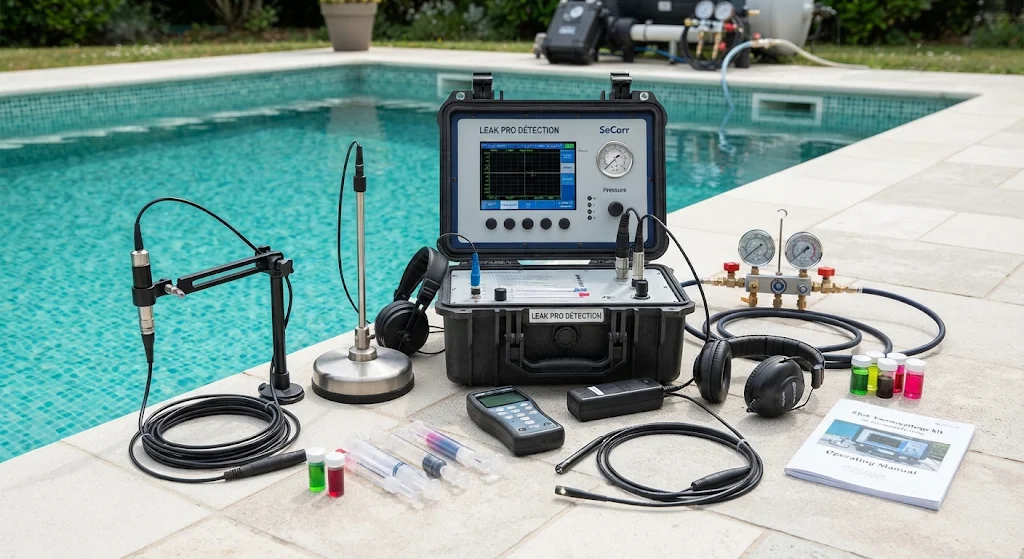
Swimming pool leaks can waste water, weaken surrounding structures, and make routine maintenance harder, yet their source is not always visible. A falling water level may point to evaporation, a plumbing fault, a damaged fitting, or a breach in the pool shell, so accurate diagnosis depends on more than a quick visual check. From pressure gauges and dye to acoustic sensors and thermal imaging, each tool reveals a different part of the problem—and knowing what it can and cannot detect helps prevent unnecessary repairs.
Diagnostic Equipment for Detecting Swimming Pool Leaks
Leak detection works best as a process of narrowing possibilities. Technicians first distinguish normal water loss from an active leak, then determine whether the likely source is in the pool structure, its fittings, or the circulation system.
A measured water-level test can help establish whether loss exceeds expected evaporation. Once that is known, specialized equipment provides evidence about the location and nature of the leak instead of relying on guesswork.
Pressure Equipment for Testing Pool Plumbing
Plumbing tests are often an efficient first step when a leak may be hidden in a return line, suction line, or other pipework. The equipment isolates a section so its ability to hold pressure can be assessed.
Pressure Testing Kits and Gauges
A pressure testing kit seals a pipe or line and introduces controlled pressure. A pipe pressure gauge then indicates whether that pressure remains stable; a consistent drop can suggest a leak, although temperature changes, loose connections, or faulty test fittings must also be ruled out.
Testing lines separately helps identify which circuit needs closer inspection. This method is particularly useful for underground plumbing, where excavation without prior diagnosis can disturb large areas unnecessarily.
Pool Leak Detection Sensors
A pool leak detection sensor may monitor pressure, flow, or water level, depending on its design. These sensors can flag unusual changes during operation, but their readings are indicators rather than exact location markers.
For dependable results, measurements should be interpreted alongside the pool’s pump schedule, valve positions, and recent maintenance. Pressure testing establishes whether a line is suspect; other tools can then help trace the fault.
Once a plumbing circuit has been checked, attention can turn to leaks in the pool shell, fittings, and concealed surfaces.
Acoustic Equipment for Locating Hidden Leaks
Water escaping through a small opening can create vibrations that travel through pipes or surrounding materials. Acoustic tools amplify and interpret these signals, allowing a trained operator to narrow down a search area without opening every surface.
Acoustic and Ultrasonic Leak Detectors
An acoustic leak detector listens for sound patterns associated with escaping water. It can be especially helpful around buried pipework, though pumps, traffic, and other background noise may complicate readings.
An ultrasonic leak detector detects high-frequency sound that is beyond ordinary hearing. Because equipment and conditions affect signal quality, technicians compare readings at multiple points rather than treating a single indication as proof.
Acoustic methods are most effective when combined with pressure testing: one identifies a potentially affected line, while the other helps narrow the location. This pairing can reduce exploratory digging and keep the investigation focused.
Visual Equipment for Inspecting Pool Surfaces
Some leaks are accessible to direct inspection, particularly around drains, lights, skimmers, return fittings, and visible cracks. Visual tools help examine these areas while limiting disturbance to the pool.
Dye Testing Kits and Underwater Cameras
A dye testing kit releases a small amount of dye near a suspected defect. If the colored trail is drawn toward an opening, it can indicate water movement at that point; currents and circulation must be controlled to avoid misleading results.
An underwater inspection camera provides a closer view of submerged fittings, seams, and surfaces. It is useful where visibility or access is limited, although it cannot confirm a leak merely by recording a crack or worn seal.
Moisture Meters and Thermal Imaging
A moisture meter measures moisture in accessible building materials near the pool, helping identify areas that may have been affected by persistent water intrusion. Results depend on the material and measurement depth, so readings need context.
A thermal imaging camera maps surface temperature differences that may be associated with moisture or water movement. It does not see through walls or independently prove a leak, but it can guide further inspection when interpreted by a qualified operator.
Equipment Selection for Accurate Leak Diagnosis
No single instrument can identify every pool leak. The right sequence depends on whether evidence points to plumbing, a submerged fitting, or moisture around the structure, and testing conditions can influence what each device reveals.
A coordinated inspection commonly draws on several tools for distinct purposes:
- Pressure testing kit and pipe pressure gauge: assess whether an isolated plumbing line holds pressure.
- Acoustic or ultrasonic leak detector: help trace escaping water through pipework or nearby materials.
- Dye testing kit and underwater inspection camera: examine suspected openings and submerged fittings.
- Moisture meter and thermal imaging camera: survey accessible areas for patterns consistent with water intrusion.
The table below summarizes what each equipment category can establish and where professional interpretation matters.
| Equipment | Primary Use | Key Limitation |
|---|---|---|
| Pressure testing kit and gauge | Checks isolated plumbing lines | Pressure loss requires confirmation of test conditions |
| Acoustic or ultrasonic detector | Locates sound signals from escaping water | Background noise can affect readings |
| Dye kit and underwater camera | Inspects visible submerged defects | Water movement may obscure evidence |
| Moisture meter and thermal camera | Surveys accessible surfaces for moisture patterns | Neither tool proves a leak on its own |
Careful testing turns scattered clues into a more reliable diagnosis, while premature repairs can address symptoms rather than the source. For personalized guidance and specialized intervention, consult a pool leak detection professional who can select and interpret the appropriate equipment.